Dec 3, 2014

Martin and Brown: Cases Highlighting Vastly Different Perceptions and an Effort to Understand Them

If you like this blog, this or any other article, please don't hesitate to subscribe and to share it with others via email, Facebook or other social media outlets!

Differing Perceptions On Display


One only needs to scroll through social media feeds, watch clips from various talking heads on cable news networks, or tune into radio news talk shows to see that there is a striking difference between most white perceptions of the Brown incident and most black perceptions of the incident.  The problem is that the perceptions on both sides neglect fundamental facts and concerns.  Rather, both sides take an "all or nothing" approach, jumping into their usual defensive postures.   Either the comment is made with the implication that Brown was not doing anything wrong and that the officer is a murderer who should have been immediately arrested; or the comment implies that racism and discrimination do not exist, and that to say so is simply "race baiting". The "race baiting" charge is then followed by a comment that is racist itself and proves the underlying biases of the comment maker.

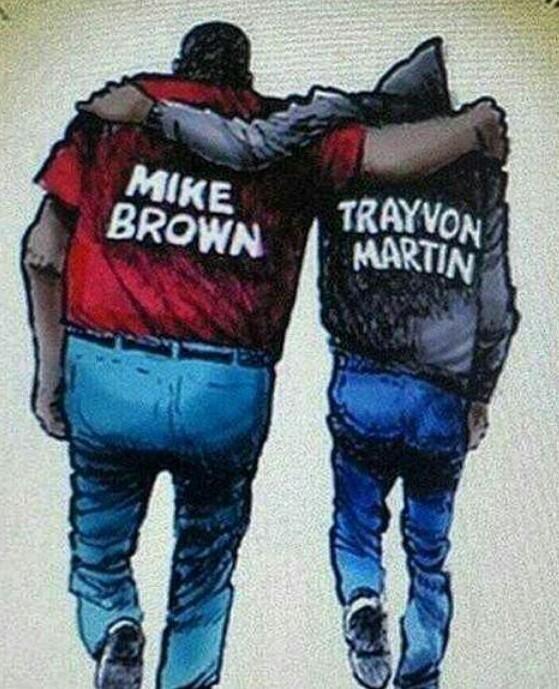
Those in support of Michael Brown equate his circumstance with that of Trayvon Martin's, intentionally or not portrays Brown as a law-abiding and non threatening teenager.  Those against the Ferguson protests also equate Brown with Martin, but with the implication that both were criminal.  Both narratives exist despite the fact that Brown had just assaulted a convenience store owner, feeling empowered even without a gun; and, despite the fact that Martin had done nothing criminal to warrant the following and harassment by George Zimmerman, who is now assumed by some as a member of law enforcement.  In one narrative they are both innocent victims and in the other equally incorrect narrative they are both criminals.  There are fundamentally different facts between these two cases that a frighteningly large percentage of Americans seem to overlook or be unaware of.   I want to simultaneously cry in sadness and pull my hair out in madness. 

Comparisons attempting to depict Wilson and Zimmerman as victims; Brown and Martin as "thugs".
Image equating the circumstance of Michael Brown with that of Trayvon Martin
My favorite, and I say this sarcastically, are the comments of those that claim to not understand why Trayvon Martin's shooting received so much media attention, while a random white guy or white girl's murder by a black man did not warrant the same attention.  Often times, I find the poster to the right is shared to prove this claim that there is a possible reverse racism or effort to "race bait".  The question in the poster: "What is the difference"?  The maker of the poster and those that share the poster fail to recognize the difference.  The difference is that in once case there was no question as to whether or not the shooter should be captured, put on trial and punished. In Martin's shooting, it appears to have taken public pressure by the black community to arrest and put on trial the shooter of Trayvon Martin.  Whether you believe the narrative or not, this is why the black community and others were outraged.  To water down the these cases to a similarity of death v. death at the hands of someone of the opposite race missed the point. This oversimplification seems to occur within both perceptions. 

Survey Data as Evidence

The differing perceptions of whites and blacks regarding race, discrimination, and treatment in the criminal justice system have been present before these two incidents.   Survey after survey supports what I anecdotally witness on the internet and television, and even among my students.  The Pew Research Center survey (right) and the first two Gallup surveys (below) illustrate that whites are more likely than blacks to believe that racial equality has been achieved and that claims of racism or bias are usually exaggerated or unjustified.  The Gallup survey results below dig into differing perceptions among blacks and whites regarding police.  


Contemplating the Origin of These Perceptions

Seeing this, it isn't hard to believe why the black community is skeptical about the account of the shooting given by Officer Wilson and the Ferguson police department.  If you look at the treatment historically of unarmed, innocent and peaceful black citizens, especially leading up to and during the civil rights movement, the distrust of law enforcement is even more understandable.  This is a history that includes the use of dogs and painful fire hoses on peaceful protesters, racial profiling in car stops, and the coordination of top law enforcement officials with lynch mobs and the KKK.  However, perceptions of whites may often neglect experiences of whites in the same way that perceptions of whites by blacks may be neglecting the experiences of blacks.

The high rates of crime in minority communities, the fact that blacks make up a disproportionate share of those in prison, and the frequent coverage of the media of crimes committed by black suspects fuel white fear and intimidation.  Whether the coverage is objective and proportionate or not is a separate matter.  The point is the views of some whites should not be lost on those that claim whites hate blacks for simply being black, claiming a racism that continues from decades of unequal treatment.  Does pure racism motivate the opinions of some?  Most likely, but this should not be the characterization of the whole group, in this case a characterization of all whites.  At the same time, it should not be assumed that all blacks hate whites as a result of historical treatment of blacks by whites.  However, the feelings of whites should not be lost on whites that claim there is no assumption made by them of wrong-doing by blacks, but then point to the high crime rate among blacks as support for the feeling they just denied as impacting their views.  While we attempt to explain our own biases, we should also confront those biases and recognize when they may be leading to an unfair and somewhat false perception of a situation, person, or group.

Confronting Perception and Bias


As a society, we cannot run from these perceptions, and we cannot deny they differ nor deny that the differing perceptions may be justified. As individuals we do ourselves an injustice, myself included, if we consistently take on a defensive and antagonistic stance.  Since we are all guilty of this, the solution is easier stated than done.  However it is not impossible for a society to confront its demons and have uncomfortable conversations.  All types of biases exist that inform our perceptions, whether they are racially motivated biases or motivated by someone's economic condition, beliefs, or weight.  We cannot deny our own biases but then argue for the bias of another.  What must equally be avoided is the act of dismissing racial biases because they are uncomfortable to talk about with a willingness to discuss less controversial biases.  Thankfully, we have seen confronting uncomfortable histories and biases successfully done in other countries without an unraveling of social order.  Both perceptions exist for a reason.  These are perceptions that have been fueled partly by reality and partly by biases that have been passed down from one generation to the next.

In a coming article I will explore in greater detail the problems with these perceptions and make specific suggestions regarding the Ferguson, Missouri protest. 

If you like this blog, this or any other article, please don't hesitate to subscribe and to share it with others via email, Facebook or other social media outlets!
 

Nov 6, 2014

The Exaggeration of the Repudiation of President Barack Obama: Analysis of the 2014 Midterm Election Results

If you like this blog, this or any other article, please don't hesitate to subscribe and to share it with others via email, Facebook or other social media outlets!

The Results of the 2014 Midterm Elections

In a nutshell, Republicans did well.  Well enough in fact in key Senate races that they took control of the Senate, gaining at least 6 seats to become the majority party in that chamber.  As of Wednesday, November 5, the Senate is poised to consist of 2 independents, 44 Democrats and 52 Republicans for the next two years beginning January 2015.  There are a couple of races still to be decided in both the Senate and the House, so Republican gains may increase by a few more seats.  In the House of Representatives, Republicans also gained seats.  Republicans will increase their seats from 233 to 243 seats in the House in January, maybe more.  As for the 36 Governor races across the country, Republicans saw gains as well.  With the exception of Pennsylvania, Republicans increased their number of states with Republican governors.  Pennsylvania is the only state that was previously held by a Republican governor and saw the Democrat win the election instead.

The Analysis: A Repudiation of President Obama?

The day after the election, the partisans, pundits and surrogates quickly offered their analysis of the election outcome.  Since Republicans gained seats and Democrats lost seats, the common conclusion became that Democratic losses were a repudiation of President Obama.  Pundits, including Political Science folks like myself, and partisans who make this claim are forming an analysis that assumes government is composed of solely the president, intentional or their part or not.  As overly focused on the president as the American people are, they still see government itself as composed not just of a president, but as being run by two opposing political parties.  Could some voters have been upset with policy choices of President Obama when they went to the polls?  Yes, of course this is true of Republicans, and this is also most likely true of some independents.  However, I argue that claims of the election results as signifying a voter repudiation of President Obama are not completely false, but are greatly exaggerated.  The media, this includes pundits, political talk show hosts, and newspaper op-ed writers, has over dramatized and over simplified the outcome of the election.  To discuss the results with reference to the complexity of the American political system, American politics, and the era of polarization would seem to lose viewers and readers.  The path of least resistance is to oversimplify, over dramatize, and focus on the figure in the government that viewers are most familiar with and curious about.

Why the 2014 Election Results Are NOT a Repudiation of Obama

There are multiple reasons, most of which are firmly based in sound political science theories, as to why viewing the Republican gains as a voter repudiation of the Democratic president are naive.

1.  If 2014 is a repudiation of President Obama, 2010 should be as well. 

And for that matter, shouldn't 2012 be one too?  But that doesn't work because President Obama received a majority of the popular vote and electoral votes, thus winning re-election.  If voters were repudiating Barack Obama in 2010 and in 2014, but loved him in between in 2012, they sure are finicky in their feelings towards the President.  Those that claim the Republican gains of 2014 are a signal of opposition to the policies of President Obama should make the same claim about 2010.  In 2010 Republicans gained seats in both the House and the Senate and Democrats lost seats in both chambers, resulting in Republicans taking back the House of Representatives from Democrats who had won control in 2006.  While Republicans won seats in the Senate in 2010 as well, unseating a few Democratic incumbents such as Russ Feingold, they did not win enough to get the majority of 51 or greater to take control of that chamber.  Nonetheless, 2010 was a huge victory for the Republican party and a huge loss for the Democratic party.  Democrats had emerged the victors in the previous two federal elections, 2006 and 2008, taking control of Congress from the Republicans who had held it since the 1994 elections.  Therefore, following the logic of the post-election pundits and partisans, 2010 must have been a repudiation of President Obama who had been elected in 2008.  Not so fast.  If that were the case, then why did voters overwhelmingly re-elect President Obama just two years later in 2012?  Obama saw only a slight increase in his approval rating from 2010 to 2012, so this cannot be explained by any significant increase in voter love of the president.  Yes, President Obama's approval leading up to the election was in the low 40s in terms of percent "approve", but most of that disapproval comes from Republican voters while only a small fraction of it comes from independents who would cause his number to go above or below 50%.  The loss of some independents in approval does not all by itself cause a loss for Democrats in general.  When independents were voting this election in states where their votes predict the outcome, they were largely voting against the party in power, rather than against Barack Obama.  President Obama's approval ratings did dip before the 2010 and 2014 midterm elections and rose to as high as 52% before the 2012 Presidential election in which he won re-election; however, correlation is NOT causation.  Approval ratings of the president can in fact reflect the feelings of the voters regarding the party in power as a whole (see point #2 below).  I argue that 2014 was no more a repudiation of President Obama than 2010 was.  In fact, the role of President Obama in predicting the outcome of those midterm elections was minimal.  The explanation lies more in voter perception of the party in control, rather than voter feelings regarding one individual in control.  There is limit to the logic that votes against non-Obama Democrats are solely a judgement on President Obama.  Link: Gallup Approval Ratings of President Obama

2.  Political science theories

The Electoral Reward and Punishment Model.  This model purports that voters either reward or punish the party they believe is currently in control of government.  If things are going well for most voters (mainly independents), they will reward the party in power.  If things are not going well for voters, again we are really only talking about independents, then they punish the party in power. I isolate this factor to independents only because voters have become very partisan in the polarized political environment we are now in.  Therefore, Republican voters will vote for Republican candidates and Democratic voters will vote Democratic regardless of conditions.  This is going to be the case for the vast majority of partisan voters, unless their is a major event or circumstance of a level that would cause some partisans to switch sides temporarily.  Therefore, independents who do not stick with one party, will base their decision largely on how they perceive the country is doing, and which party they believe is in control of government at that time.  Since Democrats were in control of government (Congress and the Presidency) from 2009 to the end of 2010, voter assessment was of the Democratic party in November 2010.  After Republican victories in November 2010, government consisted of a Republican controlled House, but a Democratic controlled Senate and Presidency. The resulting perception remained that Democrats control government.  Voters are not complex in their assessment of government control.  There is not much appreciation for the fact that opposition party control of one chamber significantly hampers the ability of the other party to take action and have legislative successes despite having control of the other chamber and the White House.  A bill must pass in both chambers to go to the President's desk for signing into law.

Partisans, pundits and news talk show hosts are claiming that the Democratic loss in November is more specifically a repudiation of Obama's policies.  Again, this is oversimplifying the results and neglecting key facts.  First, the president's policies are liberal and are that of his party.  Much like Bush's policies were conservative and hawkish, also similar to the policies of the Republican party at the time.  This does not mean there aren't some important divisions within the party, but the policies are pretty consistent overall between the president and his party.  Second, voters do not necessarily prefer conservative (Republican) policies over liberal (Democratic) policies.  It must be restated that Democrats are liberal and will vote with Democrats, while Republicans are conservative and will vote with Republicans.  Therefore, the voters that I am largely referring to are the small slice of the electorate that does not identify with a particular party.  It is these voters that decide the outcome of many elections in which Democratic and Republican voters are evenly matched.  If independents preferred one ideology over the other, than why do they seem to jump back and forth so frequently?  The move from one party to the other is solely an assessment of current conditions, and not an assessment of an ideology and its policies.  If voters are unhappy with the current state of things, such as the state of the economy, foreign affairs, income levels, or government action, they will "throw the scoundrels out", or punish them, and give the other party a chance.  If things do not improve, they will throw that party out, and go back to the other party since America is a two-party system and there is really no other choice but that one.

In 2002 and 2004 Republicans did well because Americans were rallied behind their government as a result of the September 11th attacks, giving government much of the benefit of the doubt.  The economy was doing well and Americans perceived that the government was taking action to deal with the threat.  Therefore Republicans, the party in power during running up to both of those elections (Republicans had control of Congress since 1994 and the White House since the 2000 election) they were rewarded.  In 2006, Republicans were punished as voters were unhappy with the lack of progress in both wars in Iraq and Afghanistan, increasingly feeling that the Iraq invasion was a mistake, concerned and saddened by the frequent news of soldier deaths and IED maiming, and dismayed at the federal governments lack of adequate response to conditions in Louisiana following Hurricane Katrina in 2005, and a doubling of the national debt over the Bush years and years of Republican control of Congress.  Democrats took control of the House and Senate in 2006.  By 2008, things had only gotten worse with the Great Recession of 2008.  The 2008 Presidential election was a further punishment of Republicans in Congress and in the White House as Democrats increased their numbers and won the White House over the Republican candidate. Voters still blamed Republicans who were seen as being in control for much of the time period leading up to 2008.  Two years later, with a Democratic president and a Congress that had been controlled by Democrats for four years, the voters handed out another punishment, this time to the Democrats.  The economy had not improved.  Democrats lost seats in both chambers in the 2010 midterm elections, resulting in their loss of the House to Republicans.  By the 2012 Presidential election, the economy had begun improving, which meant that voters would reward the party perceived to be in power.  This party was the Democrats as they control two of the three seats of power, the White House and the Senate.  However, by 2014, government dysfunction was the problem of the moment.  Since 2010, voters were witnessing a government that was increasingly gridlocked and unable to adequately respond to national concerns such as the growing income inequality gap and pass basic laws dealing in topics with elements that Americans agreed on. 

The President's party, whether Republican or Democrat, typically loses seats in the midterm election.  Historically, this has even been the case when the sitting president during the midterm election cycle had an approval rating above 50%, sometimes well above.  It just follows that a determination by voters about the effectiveness or competence of who is in control of government will drag down those officials, including the president, of the party in control.  Midterm elections are more difficult for the President's party because they are going to lose a number of seats that were gained when the party could ride the presidential coattails of the popular, and thus winning, presidential party nominee during the previous presidential election.  While feeling about a president should not completely be neglected in a midterm analysis, it should be recognized that voter satisfaction or dissatisfaction with a president is only one variable and not explain most or all of the votes for the other party. 

3. The map favored Republicans in 2014 for Senate, but may favor Democrats in 2016

The overwhelming majority of states that had Senate seats up for grabs were red conservative states where Republican voters tend to outnumber conservative voters.  Some of these states were gains for Republicans because in the mass anti-Republican waves of 2006 and 2008 a moderate Democrat was able to grab the independent vote and win the state.  This was bound to be undone as conditions returned to normal and the conservative state voted in a way that more reflected the ideological leaning of the state and as conditions were not what voters wanted leading to the loss of those independents to the Republican party.  In fact, over time, these states are appearing to get even redder.  Only the Republican wins in Blue states are significant supporting arguments for a Democratic punishment year.  Most of the states in the midsection of the country and the South were states with Senate elections this year.  Senate elections stretched from Montana down through the plains states to Texas and then across the deep South.  Link: 270towin.com Senate election map

4.  Turnout among Democrats is lower in midterm elections

The Democratic party has a higher proportion of minorities, youth, and single women.  These groups tend to have lower education and lower income rates, which means they have lower probabilities of voting.  The voter turnout rate among all eligible voters drops from 50-65% in a Presidential election to under 50%, sometimes as low as 40% in a midterm election when the presidency is not on the ballot.  Therefore, Democrats are hurt significantly in voter turnout in midterm elections.  This explains why they can do well in a presidential but not well in a midterm election when there is not a major event such as a recession or 9/11 driving voting behavior.  Republican voters are overall wealthier and white, which means they have higher voter turnout rates due to higher percentages of high income earners and higher education rates.  These are the voters that show up for presidential and midterm elections.  The Democratic party is more diverse, but with that diversity comes groups with historically lower voter turnout rates.  This in addition to the fact that the map favored Republicans in the Senate should not be so easily neglected by pundits and hosts since the removal of these two variables may have meant only a modest gain for Republicans, and perhaps falling short of picking up a majority in the Senate. 

If you like this blog, this or any other article, please don't hesitate to subscribe and to share it with others via email, Facebook or other social media outlets!


Oct 20, 2014

The History of State by State Moves to Ban and/or Legalize Same-Sex Marriage

If you like this blog, this or any other article, please don't hesitate to subscribe and to share it with others via email, Facebook or other social media outlets!

A History of State Bans and Legalization

History of Bans

So when did the states begin actively either banning or allowing same-sex marriage by defining marriage in a sense that excludes same-sex couples?  Well, the effort to ban same-sex marriage did not actually begin in Alaska or Hawaii.  In 1998, Alaska and Hawaii became the first states to amend their state Constitutions to ban same-sex marriage.  However, nearly several decades prior, states began banning same-sex marriage by way of a state law/statute, a bill passed by the state legislature and signed into law by the Governor.  The first state to do so was Maryland in the 1970's. By the mid 1990's nearly every state in the U.S. had a statutory ban on same-sex marriage.  Amending the State Constitution creates a ban that is a bit more permanent.  A state law can be overturned by the state's own court system as a violation of the state's constitution.  Therefore, to prevent that, some states, such as Alaska and Hawaii, began changing the state constitution by adding amendments that defined marriage as between only one man and one woman and prohibiting state recognition of same-sex marriages done in other states.  Since the ban is written into the state constitution it is automatically "constitutional".  What you are seeing today is the federal court system assessing whether or not the same-sex marriage bans, whether banned by state law or state constitution, violate the United State Constitution, which is supreme over state laws and state constitutions.  Alaska's amendment was just recently ruled as a violation of the U.S. Constitution (October 2014.  For an understanding of national supremacy on this issue see the previous post "Will the Supreme Court Take on Same-Sex Marriage...?".  Other states followed Alaska and Hawaii in amending their state constitutions.  By 2012, well over half of the states banned same-sex marriage in this manner.  This includes Georgia. In voting on a ballot measure in Georgia in the 2004 General Election, 76% of Georgia voters indicated their consent to amending the state constitution, a process requiring voter approval, "so as to provide that this state shall recognize as marriage only the union of man and woman".  Georgia's Constitution as a result of this 2004 ballot measure, now states that:
(a) This state shall recognize as marriage only the union of man and woman. Marriages between persons of the same sex are prohibited in this state. 
(b) No union between persons of the same sex shall be recognized by this state as entitled to the benefits of marriage. This state shall not give effect to any public act, record, or judicial proceeding of any other state or jurisdiction respecting a relationship between persons of the same sex that is treated as a marriage under the laws of such other state or jurisdiction. 

History of Legalization of Same-Sex Marriage

Beginning 2003, some state supreme courts begin legalizing same-sex marriage by overturning state statutory bans.  
2003: Massachusetts, begins issuing licenses in 2004
2006: New Jersey
2008: California, Connecticut
2009: Iowa
Beginning in 2009, some state legislatures and governors passed and signed bills into state law that legalized same-sex marriages and allowed for state recognition of same-sex marriages done elsewhere.
2009: Vermont, New Hampshire, D.C. (by mayor)
2011: New York
After 2011, more states see voters approving same-sex marriage through the referendum process, similar to how some states, including Georgia as mentioned above, banned same-sex marriage.  Opponents of same-sex marriage in these states that had state laws overturned or had new state laws passed to allow for same-sex marriage sought to join other states in making bans more permanent by advocating for state constitutional amendments that would ban same-sex marriage.  This is the process that played out in California in 2008.  In 2008, after a California state court overturned that state's law banning same-sex marriage, same-sex marriage opponents put the now infamous Proposition 8, similar to that of Georgia's in 2004, on the ballot allowing California voters to approve an amendment banning same-sex marriage in the California state constitution.  California voters supporting the proposed amendment accounted for about 52% of the vote which was a victory for the opponents of same-sex marriage.  Supporters of same-sex marriage in California then took a suit to the federal district court and have since won that suit, as has happened in so many other states in recent years.  California now allows same-sex marriage. 
As of today and partially as a result of the recent federal court rulings overturning state bans, 27 states now allow same-sex marriage.  This number has increased substantially in just a few years.  In 2013, only 13 states allowed same-sex marriage; and just last summer, only 19 allowed it.  The increase to 27 in such a short amount of time has been a substantial victory for the LGBT community despite their possible dismay at the Supreme Court's refusal to take up the issue which would have set the standard for all 50 states.  The National Conference of State Legislatures offers an updated map of which states allow same-sex marriage and which states do not:

However, use web links by CNN (CNN interactive same-sex marriage status) and the National Conference of State Legislatures (NCSL Defining Marriage) to stay up to date on which states allow same-sex marriage and which states do not allow it since this issue is developing rapidly.  The CNN interactive indicates the path for legalization in that state, for example, recent court rulings, although the map does not yet include the change in Alaska.  For more information on this topic, look out for an upcoming post on public opinion concerning same-sex marriage and broader questions concerning homosexuality in public opinion.

If you like this blog, this or any other article, please don't hesitate to subscribe and to share it with others via email, Facebook or other social media outlets!